
In February 2024, Jake Moffatt booked a flight with Air Canada after his grandmother had passed away. The chatbot on the website told him that he could apply for his bereavement discount afterwards. That was incorrect. The actual policy was on the next page of the site. Moffatt went to the Canadian Civil Resolution Tribunal, which ordered Air Canada to pay the difference. The ruling was clear: it does not matter whether it is an employee or a chatbot that makes the mistake. The company remains liable for what it says through its own channels (Moffatt v. Air Canada, 2024 BCCRT 149).
That ruling is small in monetary terms, but significant in signal. Ask any CFO what happens if their AI-driven customer service does the same, but with a hundred thousand interactions per month, and the arithmetic is unpleasant. Ask a CEO what happens if an AI tool misprioritises the project portfolio and three quarters of resources go to the wrong initiatives. Ask a PMO manager what happens if the risk assessment of a generative model ends up in an audit report and the accountant asks how the figures were derived. In all three cases, the answer is the same: those who can demonstrate how the AI worked, how it was tested, and who accepted it, are in a strong position. Those who cannot, are at risk.
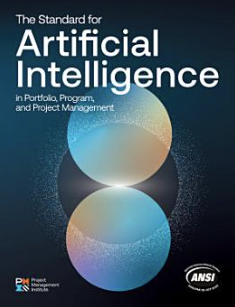
On 9 June 2026, the Project Management Institute published the first response to: The Standard for Artificial Intelligence in Portfolio, Program, and Project Management. Approved by the American National Standards Institute, technology-agnostic and built around the person who makes the final decision.
Why a standard, and why now
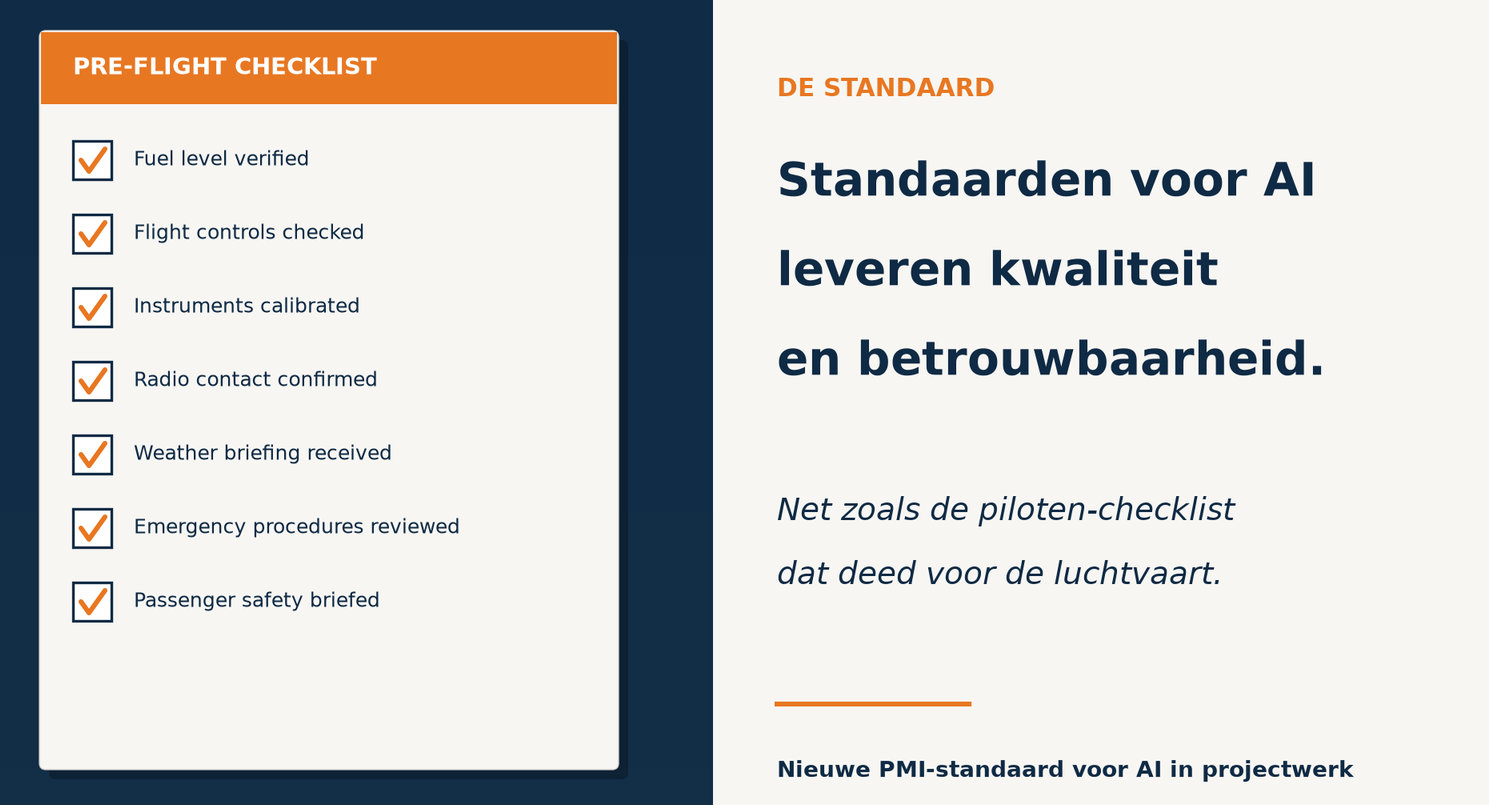
On 30 October 1935, the prototype of the Boeing Model 299, later known as the B-17 Flying Fortress, crashed during a demonstration flight at Wright Field in Ohio. The pilot, Major Ployer Hill, was experienced but had forgotten to release a simple lock on the rudder. Two crew members were killed. Critics called the aircraft too complex to fly. Boeing threatened to lose the contract. Instead of writing off the aircraft, the test pilots of the Army Air Corps came up with an invention so prosaic that no one had done it before: a preflight checklist. Since then, commercial aviation has become one of the safest modes of transport in the world. Atul Gawande describes this story in The Checklist Manifesto as the origin of the modern checklist (Air & Space Forces Magazine).
The same method was translated to the operating room by the World Health Organization in 2007. In eight hospitals worldwide, the mortality rate after surgery dropped from 1.5% to 0.8% and the number of complications from 11.0% to 7.0%. Almost a halving, from an A4 sheet of questions (NEJM · Haynes et al., 2009).
A standard is not bureaucracy. It is the prerequisite to scale something complex without accidents.
What ANSI actually is
The American National Standards Institute is the coordinating body for voluntary industrial standards in the United States, established in 1918. ANSI does not write the standards itself. It accredits the organisations that do so and ensures that the process is open, consensus-based, and reviewable. An ANSI-approved standard has passed that procedure.
What does that concretely yield? A few examples that everyone encounters without thinking about it:
- - ANSI Z87.1 specifies what safety glasses must comply with. The reason a welder does not go blind today is that the glasses meet ANSI Z87.1.
- - ANSI/ASME B1 established the thread standards in 1918. Before that time, each American factory was its own ecosystem. Standardisation enabled mass production of ammunition in World War I and later the Ford production line.
- - ANSI/ISO 9001 quality management. Research shows lower customer complaints and less rework in certified organisations.
The common thread is not that the standard is clever. It is that everyone uses the same standard. Only then does exchange, scaling, and oversight become possible. For AI in project work, that has not been the case until now.
What the PMI standard concretely establishes
Eight principles. Each AI initiative in project work must demonstrably contribute to strategic value, manage risks, comply with governance and compliance, consider people and culture, be ethically responsible, involve stakeholders, be continuously optimised, and rely on proven data quality.
Five performance domains. Strategy, Structure, Data, Technology and Stakeholders. Each domain provides the questions you need to be able to answer in every project phase.
An explicit AI life-cycle with seven phases, of which the last is often forgotten: retirement. Models must not continue to run when they are no longer valid.
Pierre Le Manh, CEO of PMI, summarised it at publication: "When the world changed with GenAI, PMI had a responsibility to provide a global framework so that project professionals can lead adoption with clarity and confidence" (PMI press release, 9 June 2026).
De standaard is technologie-agnostisch. Het schrijft niet voor welk model je gebruikt of welke tool je koopt. Het schrijft voor welke vragen beantwoord moeten zijn voordat het model in productie gaat en welke rol de mens houdt in de beslissing.
Where the PMI standard intersects with EU AI Act and ISO
The PMI standard does not stand alone. Those who apply the standard are close to what the EU AI Act and existing ISO standards require. This is intentional.
The EU AI Act came into effect in 2024, with a phased implementation that brings heavier obligations for high-risk systems in August 2026. Sanctions can reach up to 7% of global turnover. ISO/IEC 42001:2023 specifies how organisations set up an AI management system. ISO/IEC 38507:2022 provides governing bodies with guidelines for AI governance.
The PMI standard translates this legislation and standards into the world of portfolio, programme and project. If you comply with PMI, you have already organised a large part of the burden of proof for the other frameworks.
Why not everyone can simply apply this
If you read the standard, the logic is clear. When you implement it, you encounter prerequisites that many organisations have not set up.
- - Portfolio governance. Do you know which AI initiatives fit your strategy and which do not? Without structured evaluation and prioritisation, AI remains a solution in search of a problem.
- - PPM processes that support the AI life cycle. From initiation to retirement, with clear roles and gates.
- - Data quality as a prerequisite. Not as an assumption, not afterwards.
- - Role and gate distribution with human-in-the-loop. Who decides when? Who signs for the risk?
- - Tool selection that can support AI extensions. Your current PPM tool must be able to keep up.
This is exactly why many AI projects fail. The focus is on the AI operation and the output. The design constraints are not taken into account during the project. Safety, reliability, and usability become compromised. The end result becomes a liability instead of increased productivity and quality.
Why The PMO Company
The PMO Company has been working on mature PMO and PPM processes in organisations since its inception. The PMI standard is integral to the work we do: portfolio governance, PPM tool selection via projecttooling.nl, and implementation of processes that can actually support AI life cycles.
Since 2024, started with IBM WatsonX, our AI4PMO line. Goal: reliable automation and support for project managers with AI as a complement to our regular service portfolio. Two concrete pieces of evidence:
- - Vera is a virtual marketing director for The PMO Company. She operates on our own infrastructure (OpenProject, NextCloud, ZeptoMail), works with a proposal-first mandate, and documents every action in work packages. Everything that goes out is first approved by a human.
- - Soriela is een virtuele projectondersteuner die dashboards leest in context. Geen dashboard-generator, wel een tweede paar ogen dat begrijpt wat er in de cijfers verandert en waar de aandacht heen moet.
Both are built according to the principles that the PMI standard now formalises. The value judgement remains with the human.
Our advice
What we recommend for the next six months:
- Inventory where AI is already present in project work, including the silent applications. Excel plugins, mail assistants, summarisation tools in meeting platforms.
- Test against the eight principles. Where is evidence missing?
- Choose one initiative with governance weight and organise the gate review formally.
- Align with ISO/IEC 42001 as you move towards an AI management system.
- Involve the PMO early in AI initiatives, not just at delivery.
Want to know more
A comprehensive white paper with the eight principles, the five performance domains, the seven-phase life cycle, and a concrete implementation checklist is available on request. Would you like to receive the white paper? Please let us know below and we will send it to you!
White paper? JA