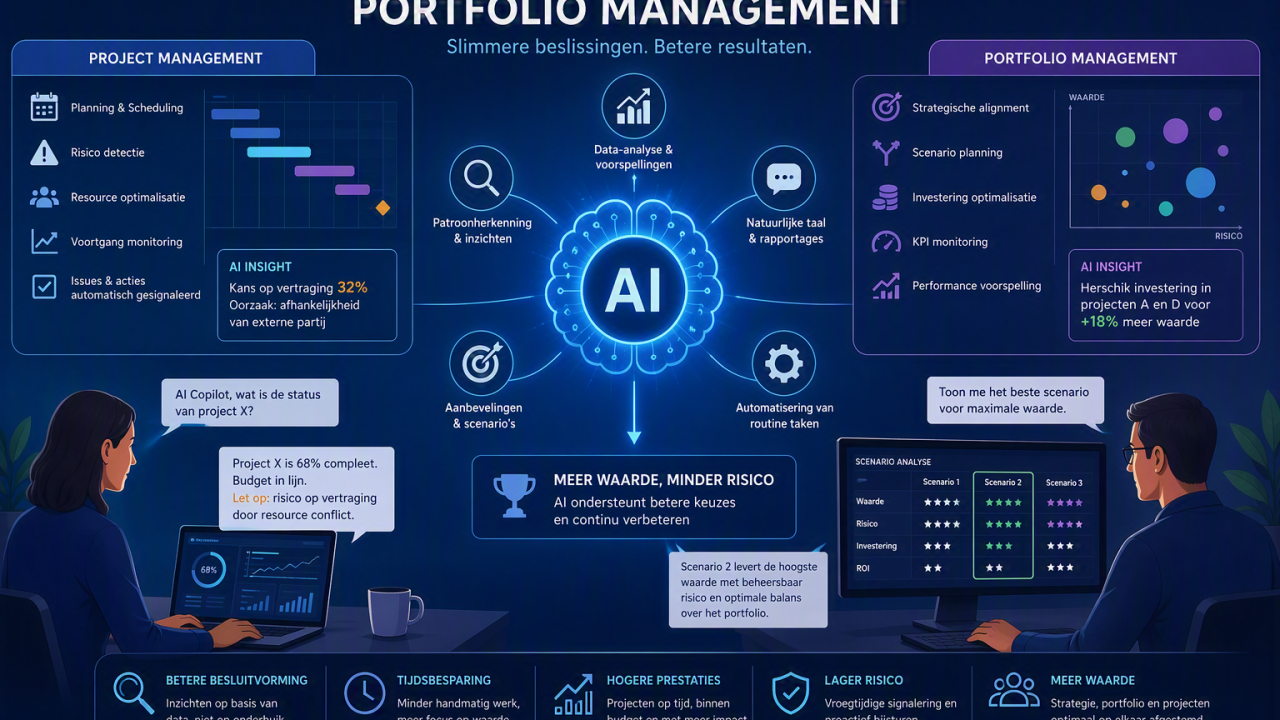
AI is rapidly transforming project, programme, and portfolio management. The possibilities seem endless: predicting risks, generating reports, analysing capacity, calculating scenarios, and even advising which projects should take priority.
Yet it is becoming increasingly clear that successful AI adoption is much less about technology than many organisations think. The recent renewal of the PMP® certification by PMI underscores exactly that point. While AI can increasingly support operational tasks, the value of project professionals is shifting towards skills that are difficult to automate: strategic thinking, business alignment, stakeholder management, decision-making, and professional judgement.
AI changes the tools, People remain responsible for the choices.
We also see this reflected in practice. Organisations implementing AI often discover that the biggest challenge is not technical in nature. Middle management is given new tasks: checking AI output, validating results, guiding teams, organising quality assurance, and simultaneously continuing normal delivery.
As a result, AI not only increases productivity but can also raise the workload.
That is precisely why AI adoption must be regarded as an organisational and governance issue rather than solely an IT implementation. Furthermore, research within the project management community shows that AI has a dual effect. Project professionals often experience greater efficiency and more opportunities to add value, but at the same time, uncertainty, stress, and questions about the future of their role also arise.
The key therefore lies in a clear positioning of AI as support for professionals and not as a replacement for them.
Psychological safety thus becomes just as important as technology.
This creates a new responsibility for PMOs. Not only the introduction of AI tools but also the creation of clear governance, explicit quality criteria, transparent decision-making, and continuous skill development. This certainly applies to portfolio management. Can AI soon determine which projects will proceed, wait, or be stopped?
From a technical perspective, AI can make a significant contribution. It can analyse strategic plans, compare initiatives, identify dependencies, signal risks, and calculate various scenarios. In this way, AI can support executives and portfolio boards in substantiating priorities and investment decisions.
Governance responsibility remains a human task; AI advises, people decide.
One prerequisite is crucial for this: reliable and connected data. Without consistent information on strategy, capacity, risks, finances, and progress, there will be no better decision-making, only automated uncertainty.
And perhaps the most important lesson lies precisely there: AI does not make bad processes better. AI makes them faster.
When processes are unclear, responsibilities are not defined, or data is of insufficient quality, AI not only accelerates the right steps. It also accelerates mistakes, duplicate work, incorrect assumptions, and wrong decisions.
Successful AI adoption begins with mature process management:
- - Clear processes
- - Clear roles and ownership
- - Reliable and up-to-date data
- - Measurable results
- - Explicit quality criteria
- - Transparent and explainable decision-making.
Only when this foundation is in order can AI truly help make project, programme, and portfolio management smarter, faster, and more effective. The future of project management will not be determined by organisations that have the most AI tools.
The winners are organisations that combine technology with governance, quality, human judgement, and continuous improvement. Because in a world where AI can do more and more, it is not technology that is the distinguishing factor. But the ability of people to make better choices based on better information.
And that is precisely where the future of PMOs lies. And that future will offer new possibilities through the development with AI, such as the Virtual Project Officer Project or VPO.